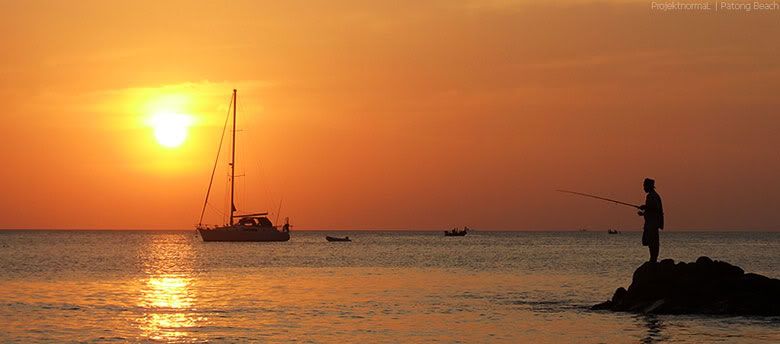
Viewing the sunset - watching the great red orb of the fading sun being swallowed by a tranquil Andaman Sea - is one of the must do things for every Thai visitor to this island. It is de rigeur to do this on even on the shortest visit. Local tradition proscribes that every Thai visitor to Phuket must make the pilgrimage to Laem Phrom Thep, one of the country’s most famous landmarks at the very southern tip of the island, before he can claim to have seen Phuket.

Any of the many high points along the west coast road will give a grandstand view. The high view-point at the back of Kata Noi beach is a particularly spectacular one – always with people, but not by the traffic jam load. The headlands north of Patong Beach alos offer numerous vantage spots, many with restaurants or stalls selling cold drinks to top off the occasion. Good vantage points are available all the way up to Mai Khao beach at the island's far northern tip, where beach-side stalls thrive on Thai clients at this time of day.

Finding a small beach bar or restaurant, settling with a cold beer or cocktail and waiting for the sun to touch the water is also an especially memorable way to absorb this god-given display. Simply strolling on the beach as the sky casts reds and pinks across the heavens is also eloquent and memorable.
Blue Panorama, an Italian charter flight airline, began operating a new route to Phuket for the winter season to increase the number of visitors from Italy. Blue Panorama Airlines has been operating direct flights connecting Rome and the tropical paradise of Phuket since its inaugural flight on 29 December 2008. To support this new development, the Tourism Authority of Thailand recently hosted an Agents Education Trip (AET) and Familiarization Trip (fam trip) for 15 agents to travel to Thailand during 27 January – 5 February, 2009. The itinerary featured the three destinations of Phuket, Bangkok and Ayutthaya.

The objective of the familiarization trip is to promote Thailand as a travel destination for the Italian Market and to restore confidence in travel to Thailand. Additionally, a Media Education Trip (MET) was conducted for 14 top-level Italian media representing television, radio and daily newspapers. Participants took part in the Bangkok to Phuket trip during 5 – 12 February 2009.

With flights being offered every Wednesday until March 2009, the newly-launched Rome – Phuket – Bangkok route is expected to play an important role in encouraging more Italian tourists to travel to Thailand. In addition, another route serving Milan – Bangkok - Phuket operates every Thursday until March 2009. If the service receives positive feedback, it will continue to operate until August. The first flight from Rome was timed to co-incide with a Christmas Day welcome and was launched on 24 December. The first flight from Milan started on 26 December. Though, this is the first service to Thailand following the 2004 tsunami incident, the route is expected to contribute to 500 tourist arrivals to Thailand per week.

The charter flights serving the Phuket-Italy route are mainly aimed at providing services for package holidays. Excess seats are sold off on a flight-only basis. By offering a more restricted service than the major scheduled or low cost airlines, the cost of these seats is highly affordable.

In 2007, the number of Italian visitors who travelled to Thailand was 159,498, or a 16.54% increase over 2006, out of which 140,999 arrived at Suvarnabhumi International Airport and 17,571 in Phuket. Visitor arrivals to Thailand at Phuket International Airport during January-August 2008 totalled 829,083, an increase of 5.24% from 787,827 arrivals during the first eight months of 2007.

Contact information:
International Public Relation Division
Tourism Authority of Thailand
Tel: +66 (0) 2250 5500 ext. 4545-48
Fax: +66 (0) 2253 7419
E-mail: prdiv3@tat.or.th
Web site: www.tatnews.org

TAT Rome
Ente Nazionale per il Turismo Thailandese
Via Barberini 68, 4th Fl., 00187 Roma, Italy
Tel: (39 06) 420 14422, 420 14426
Fax: (39 06) 487 3500
E-mail: tat.rome@iol.it , tatrome@tat.or.th


Coral reefs - globally significant diversity

The Thai Andaman Bioregion is home to over 300 species of the world’s 800 species of reef-building corals. A quarter of the world’s fish species are to be found here in about 1,200 square kilometres of coral reefs that support about two-thirds of the diversity of Australia’s much larger Great Barrier Reef, which is 344,400 square kilometres in area.

Sea grass beds
Shallow waters stretching from Phang-nga Bay to Trang support concentrations of important sea grass and serve as feeding grounds for the highest number of dugongs anywhere in the world outside Australia.

Offshore islands
The Surin and Similan islands form an extension of Myanmar’s Mergui Archipelago. Here, southern and northern flowing ocean currents converge in the eastern Indian Ocean and feature large underwater granite boulders. These characterize world-class diving spots noted for their diversity of marine fish, corals and crustaceans. Further south, ocean currents that flow northwards up the Straits of Malacca from Indonesia and the South China Sea converge with currents from the Bay of Bengal and the Indian Ocean. In this unusual part of the world, Hin Daeng and the islands of Racha, Adang and Rawi boast even greater marine fauna diversity.

Caves and karsts
At Phang-nga Bay between Phuket and Krabi province, towering karst pinnacles covered with scrub forest and plants march seawards from the north, forming caves and arches at sea-level and below. Macaques, serow and flying foxes are some of the distinctive fauna peculiar to this distinctive habitat. The area is immensely popular with sea canoeists. Above them, world-class rock faces offer avid climbers serious challenges and truly spectacular views.

Forests and swamps
Nearly 300 species and subspecies of forest birds reach their southern or northern-most distributions around the Isthmus of Kra, an area eleven to thirteen degrees north of the equator where the Thailand peninsula is only 45 kilometres wide. This means the rainforests in the Andaman bioregion are exceptionally diverse in birdlife. The phenomenon dates from ancient times when sea levels alternately rose and fell, isolating the bird populations of Indochina to the north from those of the Philippines, Malaysia and Indonesia to the south in the evolutionary process.

At the Thai-Malay border, almost 600 genera of flowering plants reach their southern or northern limits. This is evidence of a second prehistoric event that shaped the unique biota of Southeast Asia. In the south and the north, old-growth mangrove forests form wide swathes, harbouring the early life stages of every marine creature found in the sea.

Coastal dunes — the world’s most important nesting sites for marine turtles
At Khao Lak, Tai Mueang and north Phuket, coastal dunes protect beach forests and sleepy lagoons, forming some of the most important nesting areas for leatherback and other turtles in the region.

Rest stops for migrating birds and whale sharks
Tidal mud-flats in the Trang, Krabi and Kraburi River estuaries, along with coastal flats in Phang-nga Bay, are internationally important feeding areas for migratory wader birds. Raptors use the forest corridor leading down the peninsula for their annual migration. In October, over a dozen species of raptors can be seen flying south over Thaleban National Park. Whale sharks frequent the Andaman coastline from October to May. Researchers postulate that whale shark movements are responsive to plankton levels and currents from the Bay of Bengal, both of which increase at this time of year.

The natural wonders of this stretch of the Andaman coastline form treasures that do not belong exclusively to any one nation. Serendipitously, they are to be found in Thailand but form part of the whole world’s heritage — a heritage for all mankind to share and enjoy. Promoting this notion has been a central plank of the Andaman Bioregion Project.

Protecting and Preserving Thailand’s Andaman Coastline
Although parts of the Andaman coastline have been impacted by various developmental and environmental pressures, and by tourism-related activities, eighteen coastal and marine national parks covering 5,380 square kilometres already receive some level of official protection. A further four wetland areas are protected as RAMSAR sites. RAMSAR is an international agreement to conserve and wisely use wetlands of special significance in 158 countries. Thailand has been a signatory to the treaty since 1998 and has nominated ten sites totalling 370,600 hectares for inclusion. Two-thirds of these lie in the Andaman Bioregion.

The Andaman Bioregion Project – Key Approach
The traditional approach to managing Thailand’s Andaman Coastline has been to protect this treasured set of existing national parks. Individual parks might justify nomination as World Heritage Areas. According to marine biology expert Dr Thon Thamrongnawasawat, places such as Phang-nga Bay where karsts, mangroves, coral and sea grass beds meet, easily make the inclusion grade on the grounds of diversity alone. So too would locales further offshore such as the Surin Islands, where human impact is lower and more easily managed. By comparison, the Andaman Bioregion proposal in its complete form is a visionary approach to managing regional diversity with a solid grounding in science. Dr James True, the plan’s main architect, says it draws lessons from managing the Great Barrier Reef ecosystem by incorporating existing protected areas as the core features, but including other areas as buffers and special management zones. There are also exclusion zones for areas that are heavily degraded and cannot be protected.

Thais have long considered their Andaman coastline a biological treasure. Now scientists are able to demonstrate why this is so, and in so doing they are supporting its nomination as Thailand’s sixth World Heritage Area — the kingdom’s first in the marine realm.

Via : www.tatnews.org

eXTReMe Tracker